

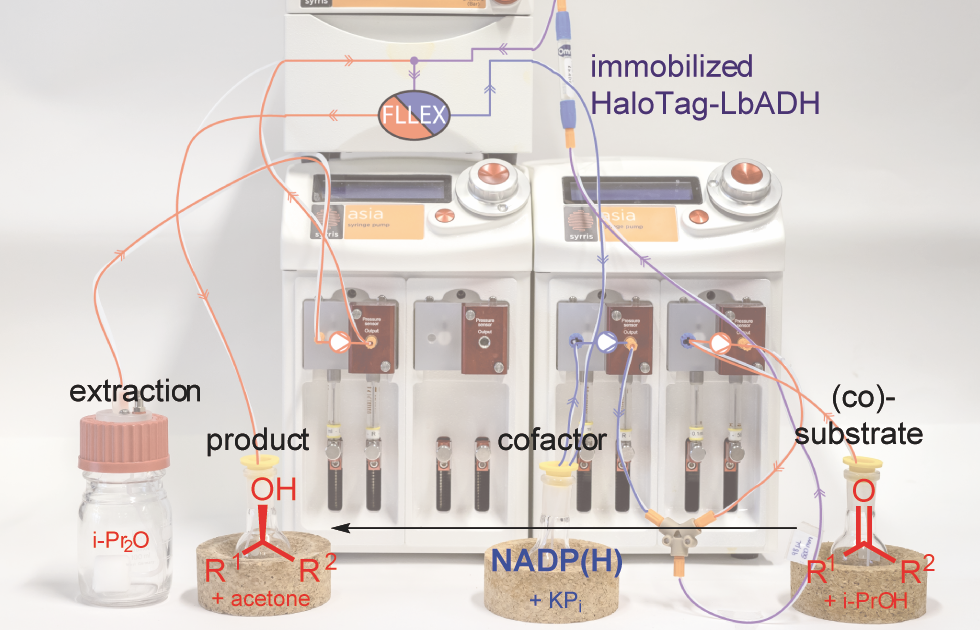
Baumer et al. recently reported on a possibility to recycle the redox cofactor NADPH in biocatalytic flowchemsitry applications. And recycling can be taken literally, because while the substrate is continuously converted into the product, the cofactor remains in the reactor. The expensive cofactor is not flushed out. After five days, the test reactor with an alcohol dehydrogenase has lost nothing in terms of selectivity and conversion.
The reactor with the alcohol dehydrogenase is only a proof-of-principle: However, we assume that this design is transferable to a large number of oxidoreductases that use NAD(P)H. Since the susbtrate is also transported in an organic solvent, this opens up many possibilities for combining biocatalysis and other chemical synthesis methods.
Great work Benedikt! You can find the study here: https://doi.org/10.1002/adsc.202000058.