© J. Org. Chem. 2026, 91, 6929−6937


The synthesis of natural products is one of the most challenging and fascinating aspects of organic chemistry. Their often high structural complexity, wealth of functional groups and pronounced biological activity make them particularly attractive target molecules. Their targeted production in the laboratory enables a deeper understanding of biological processes and provides access to potential active ingredients for applications in medicine, agricultural chemistry and materials science.
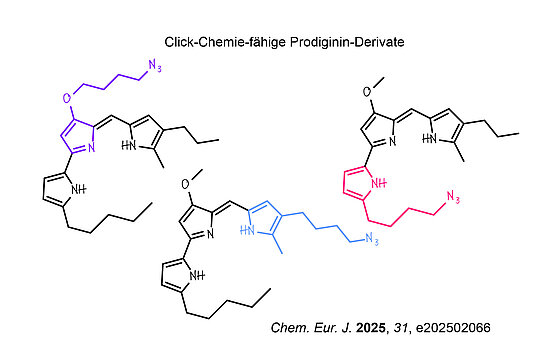
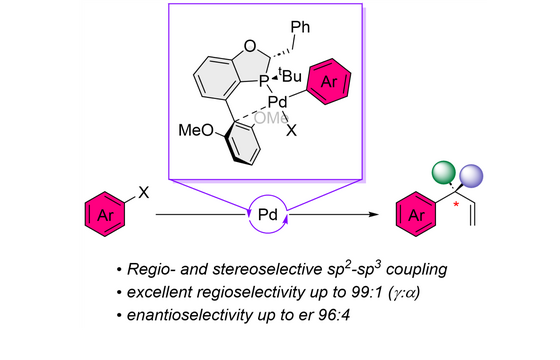
In recent years, we have succeeded in synthesising a large number of challenging structures. In the field of biaryls, for example, the natural products (+)-isocotanin A and (+)-di-epi-gonytolide A were successfully produced in an atropesic manner. Advances in mutasynthetic chemistry have given us access to a wide range of prodiginine derivatives, among other things.
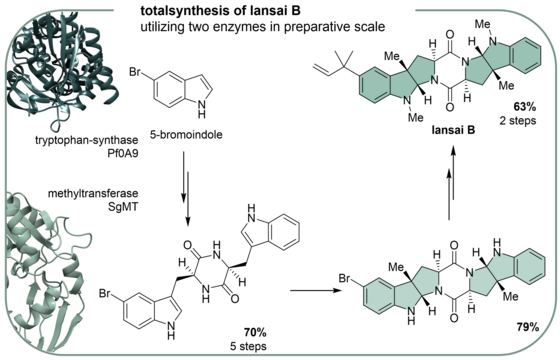
Another interesting structural motif is 1,2,3,3a,8,8a-hexahydropyrrolo[2,3-b]indole (pyrroloindole), which is frequently found in biologically active natural products. The rigid, tricyclic structure of this class of compounds enables a high affinity to various protein targets through hydrophobic interactions. Their stereoselective synthesis is a particular challenge that can be overcome by chemoenzymatic methods. Pyrroloindoles, which have a 2,5-diketopiperazine (DKP) core, are also a common motif for natural products with interesting physiological properties. They have the ability to form hydrogen bonds as both acceptors and donors, and thus interact effectively with a variety of receptors. An example is the natural product Lansai B, which we have successfully produced via a chemoenzymatic synthesis route.